Types Of Inheritance In Python: Complete Guide With Examples

Types of Inheritance in Python

“Types of Inheritance in Python” is a topic that many students think is easy at first, but confusion starts when multiple forms are introduced.

Inheritance is one of the core concepts of Object-Oriented Programming in Python, and understanding its different types helps you design structured, reusable, and scalable code.

In this article, I will clearly explain the types of inheritance in Python, how they work, and when you should use each one. So, your foundation in OOP remains strong and practical.

TL;DR: Types Of Inheritance In Python

Aspect

Summary

Core Idea

Inheritance allows one class to derive properties and methods from another class. It promotes code reuse and structured OOP design.

Main Types

Python supports Single, Multiple, Multilevel, Hierarchical, and Hybrid inheritance. Each type represents a different class relationship structure.

Key Concepts

Parent class provides behavior, child class extends or overrides it, and every class ultimately derives from the object class.

MRO Importance

Method Resolution Order decides which method runs in multiple inheritance. It follows a fixed search path and avoids ambiguity.

Best Practice

Use inheritance only for true “is-a” relationships. Prefer clean design, shallow hierarchies, and thoughtful method overriding.

What Is Inheritance In Python?

Inheritance in Python is one of the pillars of Object-oriented programming. It allows one class to inherit or derive the features or properties of the other class.

The class that derives the properties is known as the derived class or child class. The class whose properties are inherited is known as the base class or parent class.

It is important to note that there can be multiple child classes for a particular parent class. It is also possible to have multiple parent classes for one child class.

Inheritance is a fundamental idea in writing reusable and organized code. It works especially well when you structure your project into modules and packages. If you want to see how larger Python projects group related classes and functions, check out Creating and using Python Packages. It gives practical insight into managing code at scale.

Inheritance allows us to organize our code and streamline it by defining a hierarchical structure of classes and objects. It also promotes code reusability.

What Are The Key Concepts Of Inheritance? Read Below

Before diving into the types of inheritance in Python, let us go through some of its key concepts. These will help us understand the purpose and implementation of Python inheritance.

There are 3 main things that you should know about –

1) Parent class or Base Class:

The base class or the parent class is the one whose attributes get inherited by another class. These attributes can be variables or functions that identify or define an object’s behavior. The methods defined in the parent class can be directly accessible in the child class.

Have a look at the example code given below to get an idea.

				
					# Parent Class (Base Class)
class Animal:
    def __init__(self, name):
        self.name = name
    
    def speak(self):
        return f"{self.name} makes a sound."


In the above example, we have an Animal class with an attribute ‘name,’ and the method speak(). If we use this as a parent class, the child class will directly be able to inherit the ‘name’ and speak() attributes of this class.

2) Child class or Derived Class:

The child class or the derived class is a class that inherits the properties or attributes of the parent class or the base class. Inheritance in Python allows the child class to access the methods and attributes of the parent class for performing operations.

A child class can also create its methods and attributes. It can also modify or override methods of the parent class to provide a specific behavior.

Take a look at the code below:

				
					# Child Class (Derived Class)
class Dog(Animal):
    def speak(self):
        return f"{self.name} barks."


In the above snippet, the class Dog is the child class having the Animal class as its parent class. The parent class can be represented in parentheses while defining the child class.

3) Object class:

The object class is the root class of all the classes in your Python program. It’s the parent class from which all the other classes inherit either directly or indirectly.

It has some universal methods like __init__, __str__, or __eq__. We can apply these standard methods to all objects in Python. A simple code example is given below.

				
					# Explicitly inheriting from Object Class
class Person(object):
    def __init__(self, name):
        self.name = name

    def __str__(self):
        return f"Person: {self.name}"


In the above example, the Person class is inherited from the object class explicitly. However, it is not required to explicitly inherit from it in Python 3, as it is a default functionality in this version.


Why Do Students Find Different Python Inheritances Confusing?

Over the years of teaching Python and object-oriented programming, I have noticed that students find inheritance easy in the beginning, but end up being overwhelmed.

The real problem is not Python itself, but the mental model that students form about inheritance. From my experience, I am listing down some reasons why students find different Python inheritances confusing.

1) Too Many Types Of Inheritance At Once:

Students first learn about simple inheritance, and they get comfortable there. Later, they are introduced to multiple, multilevel, hierarchical, and hybrid inheritances.

This sudden jump in types creates conceptual overload for students.

				
					class A:
    def show(self):
        print("Class A")

class B(A):  # Single Inheritance
    pass


This Single Inheritance looks simple, so students assume inheritance is always this straightforward. Confusion begins when more parent classes get added, and the structure stops looking linear.

2) Multiple Inheritance And Method Resolution Order (MRO):

When two parent classes have the same method, students struggle to understand which one Python chooses. The internal Method Resolution Order (MRO) feels invisible and unpredictable.

				
					class A: # Class A Definition
    def greet(self):
        print("Hello from A")

class B: # Class B Definition
    def greet(self):
        print("Hello from B")

class C(A, B):  # Multiple Inheritance
    pass


If we call ‘C().greet(),’ Python follows a specific MRO rule. Students get confused because they don’t see why one parent is prioritized over the other, and hence, they get confused.

3) Confusion Between “Is” And “Has” Relationships:

Students often misuse inheritance where composition would be clearer. Inheritance uses the “Is” relationship, but composition uses the “Has” relation.

Students often extend classes simply to reuse code, not because there is a real “Is” relationship.

				
					class Engine: # Class Engine Definition
    def start(self):
        print("Engine started")

class Car(Engine):  # Inheritance Used
    pass


Here, the car “is” not really an Engine; it “has” an engine. This misunderstanding makes inheritance feel logically inconsistent and harder to grasp.

Understand Different Types Of Python Inheritance With Examples

Python is an object-oriented programming language that writes its code in the form of Python classes and objects. We already know about the basic terminologies of Python inheritance, like Parent class, child class, objects, attributes, etc.

Now, it is time to finally see how we can use class inheritance in our Python program. The following are the types of inheritance in Python.

  • Single Inheritance

  • Multiple Inheritance

  • Multi-level Inheritance

  • Hierarchical Inheritance

  • Hybrid Inheritance

So, let us start discussing the types of Python inheritance in detail with the help of code examples to gain a better understanding. Read below to know!

1) Single Inheritance:

It is also known as simple inheritance. In this type of Python inheritance, one child class derives the attributes of a single-parent class only.
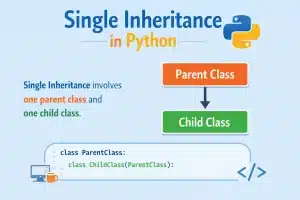
Visual Repressentation of Single Inheritance where a single parent class has used to inherit data

Let us take the example of the animal class and its child class, the dog, to see how it works. The code for the same is given below.

				
					# Parent Class (Base Class)
class Animal:
    def __init__(self, name):
        self.name = name
    
    def speak(self):
        return f"{self.name} makes a sound."

# Child Class (Derived Class)
class Dog(Animal):
    def speak(self):
        return f"{self.name} barks."
    
# Creating Objects
dog = Dog("Buddy")
print(dog.speak())  


Program Explanation:

  • We have an Animal class that has a name attribute and the speak() method.

  • We have created the class Dog that extends the functionality of its parent class, i.e., Animal.

  • The object that will be created will be of the child class.

  • When we call the method speak(), it overrides the speak() method of the parent class,s and the function returns the content of the speak() method of the child class.

Output:

Output image for the Single Inheritance Code in Python where 'Buddy Barks' is coming as the result

From the above output, it is clear that the statement from the class Dog was printed instead of the statement in the class Animal. Thus, this is how single inheritance takes place.

When To Use Single Inheritance:

  • Use single inheritance when there is a clear “is” relationship, like a Dog is an Animal, and the child truly extends the parent’s behavior.
  • When you want to reuse the common functionality and then slightly modify or override it in the child class.
  • If you are building beginner-level or clean object-oriented designs and want to keep your structure simple and easy to debug, then go for it.

2) Multiple Inheritance:

In multiple inheritance, one child class can have multiple parent classes. This kind of inheritance is useful when you need to combine the functionalities from different sources.
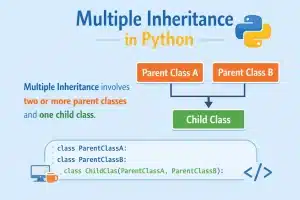
Image showing the Multiple Inheritance where two parent classes are used to inherit data to a single child class

Let us consider an example where the class employee is the child class that has the Company class and Person class as the multiple base classes. The employee class can inherit attributes from both of these classes.

The Python program for the same is given below. Have a look at it to understand the implementation.

				
					# Parent class 1
class Person:
    def __init__(self, name):
        self.name = name

    def introduction(self):
        return f"My name is {self.name}."

# Parent class 2
class Company:
    def __init__(self, company_name):
        self.company_name = company_name

    def company_info(self):
        return f"I work at {self.company_name}."

# Child class
class Employee(Person, Company):
    def __init__(self, name, company_name, role):
        Person.__init__(self, name)
        Company.__init__(self, company_name)
        self.role = role

    def job_info(self):
        return f"I work as a {self.role}."

# Creating an object of the employee class
employee = Employee("Alice", "CodingZap", "Programming Expert")

print(employee.introduction())   
print(employee.company_info()) 
print(employee.job_info())     


Program Explanation:

  • In the above example, we have the Person class and the Company class, which are the parent classes for the class Employee.

  • Each class has its method. For instance, the Person class has the introduction() method, the Company has the company_info() method, and the Employee has the job_info() method in the class definitions.

  • We have to create an object for the child class and call the functions.

  • In the child class, when the introduction() and company_info() methods are invoked, each function from the parent class is executed.

  • This way, we are combining all the methods of multiple parent classes with the derived classes.

Output:

Output image of the Python Multiple Inheritance Code where the Name, Organization and Designation has been shown of an employee

It is seen that the child class inherits the features of both the parent classes, which is why we were able to access each method from the parent class in multiple inheritance.

When To Use Multiple Inheritance:

  • Use multiple inheritance when your class needs to combine independent capabilities.
  • When parent classes are small, focused, and designed to provide one specific behavior each, use them.
  • Use it only when you clearly understand Method Resolution Order (MRO), because method conflicts can otherwise become difficult to trace.

3) Multi-level Inheritance:

Multilevel Inheritance is like a chain of inheritance. Think of it like inheriting genes from your previous generations. You inherit your parents’ genes, who have inherited their genes from their parents.
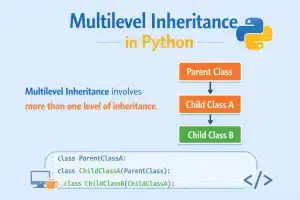
Visual Image of the multilevel inheritance where data goes from parent to child to its grandchild in different levels

Again, let us take an example where we have ‘Animal’ as the parent class, ‘Dog’ class as its child, and finally the puppy class as the child class of the dog class. The code for the same is given below.

				
					# Parent class
class Animal:
    def eat(self):
        return "Animal eats."

# Intermediate child class
class Dog(Animal):
    def bark(self):
        return "Dog barks!"

# Final child class
class Puppy(Dog):
    def sleep(self):
        return "Puppy sleeps peacefully!"

# Creating an object
puppy = Puppy()

print(puppy.eat()) 
print(puppy.bark())    
print(puppy.sleep())     


Program Explanation:

  • We have created an object of the Puppy class that also has access to the other methods of the two classes above it.

  • We can call the other methods because of the multilevel inheritance.

  • Thus, when we call the eat() and bark() methods using the same object, we can get an output.

Output:

Multi-level Inheritance Code Output Image where 3 different statements are coming for 3 different inheritance classes

We can execute the method sleep() and other methods of the above example using the inheritance concept. Thus enhancing code reusability.

When To Use Multi-level Inheritance:

  • Use multilevel inheritance when you are building a layered design, where each level adds meaningful specialization.
  • Go for it when you want to gradually refine behavior from a general class to a very specific one.
  • Use it when the inheritance chain makes logical sense and improves readability instead of making the structure complicated.

4) Hierarchical Inheritance:

In this type of inheritance, one or more child classes inherit properties from a single-parent class. It is just like having a sibling! Each child class inherits all the methods and attributes from the parent class.

Visual image of Hierarchical Inheritance where from a single parent class data is inherited to two child classes

Let us understand this with the help of a Python code example. Have a look to learn more!

				
					# Parent class
class Animal:
    def __init__(self, name):
        self.name = name

    def eat(self):
        return f"{self.name} is eating."

# Child class 1
class Dog(Animal):
    def bark(self):
        return f"{self.name} says: Woof!"

# Child class 2
class Cat(Animal):
    def meow(self):
        return f"{self.name} says: Meow!"

# Creating objects
dog = Dog("Buddy")
cat = Cat("Kitty")

print(dog.eat())  
print(dog.bark())  
print(cat.eat())   
print(cat.meow())  


Program Explanation:

  • In the above example, we have only one parent class with the class name Animal.

  • This parent class has the name attribute and the eat() method defined in it.

  • We have created two classes that act as the child class for the Animal class.

  • One of these is the Dog class that we have already seen in the previous examples. The other one is a new-class Cat.

  • Each child class inherits all the methods and instance variables from the parent class in this example.

  • We will also create objects for the two classes and call the methods for each object.

  • The parent method will also be called for each class child in the example.

Output:

Hierarchical Inheritance Code Output showing two different versions of 'Buddy' and 'Kitty' as they are gettings traits from two different parents

There is only one parent class in the example, and for the object of the dog class, the parent method prints the name attribute as ‘Buddy’, and for the new object of the new class, Cat, the parent class method prints the name attribute as ‘Kitty.’ Other methods of the dog class and the cat class are printed as expected.

When To Use Hierarchical Inheritance:

  • Use hierarchical inheritance when multiple child classes share the same base behavior but implement it differently.
  • Go for it when you want to avoid duplicating common code across similar classes.
  • Use it when you are modeling real-world systems where one base concept branches into multiple variations.

5) Hybrid Inheritance:

Hybrid inheritance in Python occurs when more than one form of class inheritance is combined. Hybrid inheritance often leads to conflicts like the diamond problem, as more than one form of inheritance is involved.
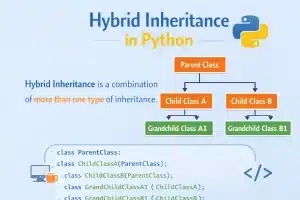
Image showing the Hybrid Inheritance in Python where two or more types of inheritances are used together

To solve this conflict, Python uses the Method Resolution Order (MRO). Every object in Python has the __mro__ attribute.

The following code represents an example of this type of inheritance. Here, we have combined multiple and multi-level inheritance.

				
					# Base class
class Animal:
    def breathe(self):
        return "Animal is breathing."

# Intermediate classes
class Mammal(Animal):
    def give_birth(self):
        return "Mammal gives birth to live young."

class Bird(Animal):
    def fly(self):
        return "Bird flies in the sky."

# Derived class
class Bat(Mammal, Bird):
    def nocturnal(self):
        return "Bat is active at night."

# Creating an object
bat = Bat()

print(bat.breathe())      
print(bat.give_birth())   
print(bat.fly())          
print(bat.nocturnal())  


Program Explanation:

  • We have a parent class named Animal. It has two child classes: Mammal and Bird. Each child class inherits all the properties of the Animal class.

  • Finally, we have class Bat, which is the child class of two-parent classes – Mammal and Bird.

  • We then created a new object for the Bat class and called the methods for each existing class.

Output:

The output screenshot of the Hybrid Inheritance Code in Python where 'Bat' inherits the traits from the child classes 'Mammal' and 'Bird'

From the above example output, we can see that we have successfully achieved inheritance in Python. However, it is important to note that if the methods had the same name or if the same method existed in each existing class, we could have encountered an error.

This kind of situation is called the diamond problem. To do this, we use method overriding in Python.

When To Use Hybrid Inheritance:

  • Use hybrid inheritance when your system genuinely requires a combination of inheritance.
  • Use it in advanced designs where you are confident about how classes interact with each other.
  • Go for it only after planning your structure carefully, because hybrid models can become difficult to maintain if designed casually.


Deep Analysis: What Is A Method Resolution Order (MRO) In Python Inheritance?

From my mentoring experience, I have noticed that when a student works with any Python inheritance other than the Simple Inheritance, they fail in the MRO Trap.

Every examiner knows about this trap, and you are supposed to get a question from there.

Simply, the MRO is the search path that Python follows in inheritance. It decides which class method gets executed. It follows a fixed, predictable order and matters most in multiple inheritances.

For a clear understanding of how Python actually searches, think of it like checking rooms in a building:

  • Python checks the current class first. Then it checks the parent classes.
  • In multiple inheritances, it follows left to right, and it moves level by level upward.
  • Python never checks the same class twice. As soon as it finds the method, it stops searching.

Students usually get confused when there are two parent classes that have the same method name, or when there is diamond inheritance. In such cases, students assume Python “chooses randomly”.

When I teach inheritance, I tell students one simple thing first: MRO is just Python’s way of deciding “Which method should I run?” Most confusion disappears once you understand the search order clearly.


Comparison Table On Different Inheritances In Python:

When students learn all five types of inheritance together, the structures start looking similar. But each type has a different purpose and pattern in real program design.

Let me simplify it for you so you can clearly see the structural difference at a glance.

Criteria

Single

Multiple

Multilevel

Hierarchical

Hybrid

Structure

Linear

Combined

Layered

Branching

Mixed

Parents

One

Many

Chain

One

Mixed

Complexity

Low

Medium

Medium

Low

High

Flexibility

Limited

Moderate

Progressive

Shared

Advanced

MRO Risk

Minimal

Present

Minimal

Minimal

Significant

Real Use

Extension

Aggregation

Specialization

Variation

Architecture

Mentor Advice: If you are just starting, focus on Single and Hierarchical inheritance first. Move to Multiple and Hybrid only when you clearly understand Method Resolution Order.


What Are Some Real-World Applications Of Different Python Inheritances?

When students study inheritance, they usually see small classroom examples. But in real software systems, inheritance solves structural problems in clean and practical ways.

I know about this assumption issue of students, so I am mentioning some of the real-world applications of Python Inheritance.

  • Web frameworks like Django use inheritance to extend base view classes into custom application views.
  • Payment systems use hierarchical inheritance to create multiple payment types from one common payment base.
  • Enterprise software uses multiple inheritance to combine logging, validation, and authentication behaviors.
  • Backend service layers use multilevel inheritance to gradually extend core database logic into business-specific logic.
  • Game development systems use inheritance to create different character types from a common base entity.

Advantages And Disadvantages Of Python Inheritance

Below are some of the advantages and disadvantages of Inheritance. Let’s examine these to better understand the concept.

Pros

Cons

It allows us to use the same elements of the code multiple times. Hence, adding code reusability.

Deep inheritance can lead to the code being complex.

It offers modularity by breaking down the code into a parent class and a child class.

Changes in the parent class can affect the changes in the child class.

The child class inherits the data members and methods of another class easily by extending the parent class.

Accidental method overriding may occur as the same method may be present in multiple classes.

The use of the built-in function super() allows the child class to automatically inherit and easily call methods of the parent class.

Inheritance may lead to potential overengineering.

Run-time polymorphism can be achieved using method overriding.

Determining the MRO in multiple parent classes may be complex.

When Not To Use Python Inheritance?

No doubt, Python Inheritance is a powerful tool, and this often leads to thinking that you can use Python Inheritance in every place. But it is not always the right option.

Here, as your mentor, I am listing down the fields where you must not use Python Inheritance.

  • Do not use inheritance when the relationship is not truly an “is” relationship, because forcing inheritance creates confusing designs.
  • Do not use inheritance just to reuse code, especially when composition would make the design cleaner.
  • Don’t go for inheritance when your class hierarchy starts becoming too deep, because debugging long inheritance chains becomes painful.
  • Do not use multiple inheritance if you do not fully understand how Python resolves method conflicts, as it can introduce subtle bugs.
  • Do not use inheritance when the parent class was not designed to be extended, because modifying behavior later may break the system unexpectedly.


Common Mistakes Students Make With Inheritance In Python:

While mentoring students, I have figured out some common mistakes students make in their exams with Python Inheritance. Go through the following list to avoid making them in your exam.

  • Students forget to call ‘super()’ in child classes, which leads to parent attributes not being initialized properly.
  • Sometimes, students override a method without realizing they are replacing important parent behavior.
  • Oftentimes, students create very deep inheritance chains that look impressive but become hard to read.
  • Students use multiple inheritance casually without checking whether parent classes have methods with the same name.
  • Sometimes, students misunderstand the order of parent classes in multiple inheritance and assume Python chooses methods randomly.

When working with class attributes and inherited properties, you will often manipulate values of different types. Python automatically converts some values, but not always in the way you expect. A clear explanation of Type conversion in Python can help you avoid common pitfalls.

Conclusion:

Now you should have a clear understanding of the “Types of Inheritance in Python” and how each one works in practice.

The real goal is not just remembering the syntax, but understanding when to use single, multiple, multilevel, hierarchical, or hybrid inheritance in real projects.

As you continue writing Python programs, focus on designing clean class relationships, using inheritance thoughtfully, and applying method overriding only when it improves clarity and structure.


Takeaways:

  • Inheritance is a way in which a child class inherits the attributes from the other class and extends its functionality.

  • There are 5 major types of Python inheritance, and each of them can be combined as per the requirements of the program.

  • You can use the special method super() that helps the child class automatically inherit properties from its parent class without using the parent class name in its definition.

  • The same method can be present in both the parent and the child class. Use method overriding to choose which function you need to call.


Frequently Asked Questions:

1) How many types of inheritance are available in Python?

Python supports single, multiple, multilevel, hierarchical, and hybrid inheritance. Each type defines a different relationship structure between parent and child classes. The choice depends on how your system is designed and how behaviors need to be shared.

2) What is method overriding in inheritance?

Method overriding happens when a child class defines a method with the same name as the parent class. The child’s version of the method gets executed instead of the parent’s version. This allows customization of inherited behavior without changing the base class.

3) Why is Method Resolution Order (MRO) important in multiple inheritance?

MRO defines the order in which Python searches for a method in the inheritance hierarchy. It prevents ambiguity when multiple parent classes contain the same method. Understanding MRO helps you avoid unexpected behavior in complex class structures.