
C Programming Homework Help That Explains Every Pointer and Every malloc

Pointers crashing your program? malloc returning NULL and you have no idea why? C does not forgive small mistakes the way Python or Java does. One wrong memory address and your whole program dumps core.

We pair you with C engineers who have built real systems in C. They write your solution with inline comments explaining every pointer, every allocation, every free() call. You get working code you can actually trace through and understand.

  • Commented Code Delivered
  • Human C Experts
  • Deadline Guarantee
Illustration showing, professional mentor at CodingZap breaking the complex logics in C programming

What you get : Every Delivery Includes These Five Things

We do not just send you a .c file and disappear. Every order ships with:

Working, Compiled Code

Your program compiles with gcc -Wall -Wextra and zero warnings. We test it against the inputs described in your assignment brief before we send it. You can use our delivered code for reference and learning purpose.

Inline Comments on Every Key Line

Not boilerplate comments like "// declare variable." Real explanations like "// allocate N bytes for the scores array, check for NULL because the system might be out of memory." You should be able to read the comments alone and understand the program flow.

A Logic Walkthrough Document

A short text file that explains the approach: why we chose this data structure, how the algorithm works step by step, and where the tricky parts are. If your professor asks you to explain your code in a viva, this document prepares you.

Input/Output Test Cases

We include the test inputs we used and the expected outputs so you can verify the program works on your machine before submitting.

Compilation Instructions

Our experts prepare a document 'readme' file where they mention exact commands to compile and run. If it is a multi-file project, the Makefile is included. No guessing on your end.

From Pointer Arithmetic to Full System Programs

Send us your assignment and we will match it to the right C expert. Here are the project types that land in our inbox every week:

Structs + File I/O Projects “Build a student records system that reads from a file, stores data in an array of structs, and lets the user search, add, or delete records.” This is the most common C assignment at the sophomore level. It tests your understanding of structured data, file handling, and basic CRUD logic.

If your assignment uses fopen, fscanf, fprintf, and struct This is the category. We write the file handling with proper NULL checks and the struct operations with clear memory management.

Learn how file handling and structured data work together in C

Linked List / Stack / Queue Implementations

The second most common C project. You have to build a data structure from scratch using pointers and dynamic memory. The tricky part is not the logic. It is keeping track of which node owns which memory and making sure you free everything when a node gets deleted.

Our code includes comments at every malloc and free call showing exactly what memory is being created or released and why.

How to implement a stack using linked list in C

Bubble sort, selection sort, quicksort, binary search. Professors want you to implement these from scratch (not use library functions) and often ask you to count comparisons or measure time complexity.

We write the algorithm with step-by-step comments explaining the logic of each pass, not just the code that compiles.

What is Quick Sort Algorithm?

Assignments where you have to use malloc, calloc, realloc, and free to manage memory yourself. Often combined with building a resizable array or a hash table.

These are the assignments where one wrong pointer crashes your whole program with no helpful error message. We annotate every allocation so you can follow the memory lifecycle.

Dynamic Memory Allocation in C

Upper-level assignments where you split code across .c and .h files, write a Makefile, and manage compilation dependencies. Professors test whether you understand how C programs are actually built, not just how to write a single main.c.

We deliver the complete project structure with the Makefile, header guards, and comments explaining the compilation chain.

“Write a simple shell that reads commands and executes them using fork() and exec().” These show up in systems programming courses and are genuinely difficult for students who have only written single-process programs before.

Operating Systems Project Ideas

Bet C Programming Help & Support at CodingZap

Does your assignment fit one of these? Send it over. Does it not fit neatly into any category? Send it anyway. If it is written in C, we can handle it.

What Does C Programming Help Cost?

Assignment TypeTypical PriceTurnaround
Short lab exercise (single function, 50-100 lines)$35 – $5024 hours
Weekly homework (multiple functions, 100-300 lines)$55 – $8024-48 hours
Multi-file project with Makefile (300-800 lines)$100 – $1602-4 days
Final project or capstone (800+ lines, documentation)$200 – $3503-7 days

Urgent delivery (under 12 hours): Add 40-60% to the above.

Exact price depends on the assignment complexity, deadline, and whether documentation or a viva prep walkthrough is needed. Send your assignment brief and we give you a fixed quote within 2 hours. No surprises after you agree.

Three Steps to Get Your C Assignment Done

“A student sharing assignment details through an online form.”

Step 1: Share Your C Assignment

Send us your assignment PDF, the rubric, any starter code your professor provided, and your deadline. You can upload through the form, email us, or message on WhatsApp.

Step 2: Get a Quote and Choose Your Expert

We review your assignment and send back a fixed price within 2 hours. You see which C expert will work on it and their background. You pay only after you agree.

A coding expert from CodingZap is working on logical building
Illustration showing student learning and applying the learned logics and gaining confidence

Step 3: Receive Code + Walkthrough

You get the completed code, inline comments, test cases, compilation instructions, and the logic walkthrough document. If anything is unclear, you can ask your expert follow-up questions.

Meet Your C Programming Experts

Vetted C engineers and system architects who help you deconstruct memory logic, pointers, and manual resource management.

Online
Sophia Carter

Sophia Carter

C & C++ Programming Lead

Education:B.S. CS
Experience:6+ Years
C Specialty:Pointers, malloc/free, File Handling
Online
Jobi Besong

Jobi Besong

System Programming Expert

Education:M.S. CS
Experience:8+ Years
C Specialty:Linux Kernel, multithreading, GDB
Online
Khizer

Khizer

Technical Tutor & Developer

Education:M.S. CS
Experience:5+ Years
C Specialty:Structures, Arrays, Logic Debugging
Online
Asad Rehman

Asad Rehman

Lead Technical Mentor

Education:B.E. (CSE)
Experience:8+ Years
C Specialty:Data structures in C, Makefile projects, system-level programming.
Globally Celebrated by Thousands of Students!

What Students Say About Their Experiences

We’re proud to support students who want to understand C programming more clearly and confidently.
Rated 4.5 out of 5

“I was stuck on my C project because I didn’t understand how memory allocation was working. The explanations helped me finally connect the logic. I felt much more confident after that.”

Kelly, Georgia, United States
Rated 5 out of 5

“I struggled with a Linux-based C assignment for weeks. What helped most was breaking the logic down step by step instead of just trying random fixes.”

Donte Batts, Maryland, USA
Rated 4 out of 5

“My biggest issue was debugging segmentation faults. After understanding how pointers were behaving in memory, I started solving similar problems on my own.”

Mike, Melbourne, AUS
Rated 5 out of 5

“The guidance helped me explain my own solution clearly during evaluation. That made a big difference in how I approached the course.”

Omar, Florida, USA

Why Your C Program Crashes (And What Your Professor Won't Slow Down to Explain)

Every C crash comes down to one thing: you accessed memory you should not have. Here is the short version of how C memory works, because once you see it, debugging gets a lot less scary.

When your C program runs, it gets two areas of memory:

The Stack is where local variables live. When you call a function, C creates a “frame” on the stack for that function’s variables. When the function returns, that frame is destroyed. If you return a pointer to a local variable, you are pointing at memory that no longer exists. That is why your program crashes when you try to use it later.

The Heap is where malloc gives you memory. This memory survives until you explicitly call free(). If you forget to free it, you get a memory leak. If you free it and then try to use it again, you get a “use after free” crash. If you write past the end of a malloc’d block, you corrupt whatever sits next to it in memory.

Most segmentation faults in student assignments happen because of three things:

  1. Dereferencing a NULL pointer (you called malloc but did not check if it returned NULL)
  2. Using a pointer after the memory it points to was freed
  3. Going past the end of an array (writing to index 10 of a 10-element array, when valid indexes are 0-9)

Visualizing the "Segmentation Fault" Logic

A Segmentation Fault isn't random. It’s a vital safety feature where the Operating System stops your program from accessing unauthorized memory zones.
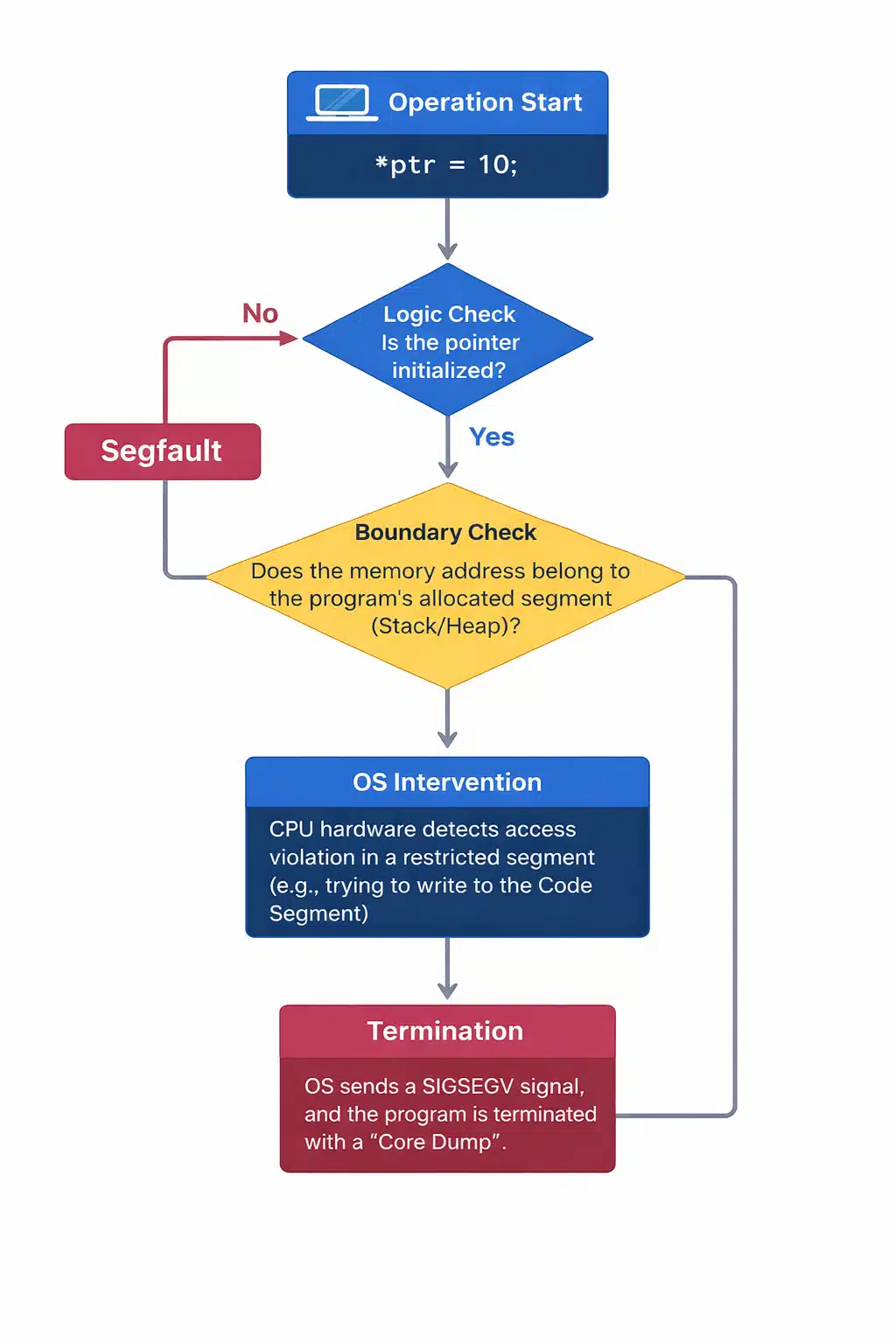
Flowchart deconstructing a C programming segmentation fault from pointer initialization to the SIGSEGV signal
Our Expert Perspective:

"Most students see a Segfault and start changing their code randomly. We guide you to use professional tools like GDB (GNU Debugger) or Valgrind to map your pointers back to this specific flow. Once you identify exactly which 'boundary' was crossed, the fix becomes logical rather than a guessing game."

When you get your code from us, we add a comment at every pointer operation explaining which of these risks it avoids and why.

How to Debug Segmentation Fault in C Homework

See How We Actually Fix a Crashing C Program

Here is a real example (simplified from an actual student project) showing how we trace and fix a segfault.

1 The Broken Code
2 What We Found
3 The Fix + Comments
What the student sent us
$ gcc scores.c -o scores && ./scores
Segmentation fault (core dumped)
scores.c
#include <stdio.h>
#include <stdlib.h>

int main() {
    int *scores = malloc(5 * sizeof(int));
    for (int i = 0; i <= 5; i++) {   // Bug: <= should be <
        scores[i] = i * 10;
    }
    printf("Last score: %d\n", scores[5]);  // Bug: out of bounds
    free(scores);
    return 0;
}

The student saw "Segmentation fault (core dumped)" with no other information. The program compiled fine but crashed the moment it ran.

What we found

The loop runs from 0 to 5 (six iterations) but only 5 slots were allocated (indexes 0 through 4). Writing to scores[5] goes one position past the allocated block.

On some systems this corrupts memory silently. On others it crashes immediately. This is called a buffer overflow and it is one of the most common bugs in student C assignments.

The fixed code
scores.c (fixed)
for (int i = 0; i < 5; i++) {   // Fixed: < instead of <=
    scores[i] = i * 10;
}
printf("Last score: %d\n", scores[4]);  // Fixed: last valid index is 4
Comments we added to the delivery
inline comments
// malloc gives us exactly 5 slots: index 0, 1, 2, 3, 4
// writing to index 5 goes past the end of allocated memory
// this is called a "buffer overflow" and it causes
// undefined behavior
// on most systems it either crashes (segfault) or
// corrupts nearby data

This is the kind of line-by-line clarity we include with every delivery. You do not just get code that works. You get code you can explain.

If your program is crashing and you cannot figure out why, send it to us.

Read more: Errors in C Programming Explained
Get My C Code Fixed

Study Real C Program Examples (For Learning & Practice)

Looking at clean, structured code can help you understand how programs are organized in real academic settings.

These examples are meant for study and reference purposes so you can analyze structure, memory handling, and logic flow.

Sample Coding Solutions

Data Structures Example

Understand how arrays, linked lists, and structured data are organized in C.

Sample Coding Solutions

File Handling & Structured Program Example

See how file input/output and structured design work together in a practical program.

Sample Coding Solutions

Control Flow & Logical Conditions Example

Study how conditional statements and loops are used in a real grading system program.

Why Students Still Need Human Help for C (Even with AI)

You have probably already tried pasting your assignment into ChatGPT. And it probably gave you code that looked right but crashed, or compiled but failed your professor’s hidden test cases. Here is why:

AI tools do not test the code they write.

They generate code that looks syntactically correct but often has off-by-one errors, missing NULL checks, memory leaks, and incorrect boundary conditions. For C specifically, these are the exact bugs that cause segfaults, and AI tools are terrible at catching them because they do not actually run the code.

AI cannot read your professor’s rubric.

Your assignment has specific requirements about coding style, header files, function signatures, Makefile format, and output formatting. AI gives you generic solutions. We read your actual assignment document and matched the requirements exactly.

AI cannot explain itself during a viva.

If your professor asks, “Why did you use calloc instead of malloc here?” you need to actually understand the answer. Our logic walkthrough documents prepare you for exactly these questions.

AI code has no comments that help you learn.

It might add // allocate memory above a malloc call. Ours says // allocate 10 integer-sized blocks on the heap because we need a resizable buffer that outlives this function.

We are not anti-AI. For simple Python scripts or HTML pages, AI tools work fine. But C is a language where one wrong byte crashes everything, and that is where human expertise matters.

Every C Topic Your Course Throws at You

We have published detailed guides on most of these topics. Click through to learn on your own, or send us your assignment and we will handle it for you.

🎯

Pointers & Pointer Arithmetic

Memory addresses, dereferencing, pointer-to-pointer, and why misuse causes segfaults. The foundation of everything in C.

Read our guide
🧠

Dynamic Memory (malloc, calloc, free)

Heap allocation, realloc for resizing, proper NULL checks, and preventing memory leaks in every assignment.

Read our guide
📊

Arrays & Multidimensional Arrays

Contiguous memory storage, indexing, boundary conditions, and passing arrays to functions without losing size info.

Read our guide
🔄

Recursion & Control Flow

How function calls stack in memory, base case design, loops vs recursion tradeoffs, and switch/conditional logic.

Read our guide
🔗

Linked Lists, Stacks & Queues

Node creation with malloc, traversal, insertion, deletion, and making sure every free() matches every allocation.

Read our guide

Sorting & Searching Algorithms

Bubble sort, selection sort, quicksort, merge sort, and binary search. Implemented from scratch with comparison counting.

Read our guide
🌳

Binary Search Trees

Insert, delete, search, and traverse operations. Understanding height, balance, and when a tree degenerates into a list.

Read our guide
⚙️

Preprocessor Directives & Macros

#define, #include guards, conditional compilation, and inline functions. The stuff that runs before your code compiles.

Read our guide
🐛

Error Handling & Debugging

Syntax errors vs runtime errors vs logical errors. How to read gcc warnings and use them to find problems before they crash.

Read our guide
💥

Segmentation Faults

NULL dereferences, use-after-free, buffer overflows. The three crashes every C student hits and how to trace them.

Read our guide
🔀

Control Flow (Loops & Conditionals)

for, while, do-while, if-else chains, switch statements, and nested logic that professors use to test your thinking.

Read our guide
🧮

Classic C Programs

Fibonacci series, factorial, palindrome checks, prime number generators. The starter assignments that build your C muscle memory.

Read our guide
📝

C Syntax Fundamentals

Data types, variable declarations, operator precedence, and the syntax rules that trip up students moving from Python to C.

Read our guide

If your assignment covers a topic not listed here, send it anyway. We have handled everything from bitwise encryption to custom memory allocators.

Send My C Assignment

FAQs – C Programming Questions Students Ask Before Ordering

We handle lab exercises, weekly homework, multi-file projects with Makefiles, data structure implementations, sorting algorithm programs, file handling assignments, and final year capstone projects. Basically anything your C programming course assigns.

Real C engineers with 5-8+ years of experience. Not AI tools, not offshore content farms. Each expert has a specific specialty listed on their profile. You can see who is working on your project before you pay.

Yes. We compile and test with gcc -Wall -Wextra before delivery. We include the exact compilation commands and test inputs so you can verify everything works.

ChatGPT generates code it never tests. For C, that means missing NULL checks, off-by-one errors, memory leaks, and buffer overflows that cause crashes. We write, compile, test, and annotate every program. Plus we include a logic walkthrough so you can explain the code during a viva.

We write defensive code that handles edge cases: empty inputs, maximum values, invalid data, and boundary conditions. If you share the autograder requirements (or even what errors you have been getting), we build the solution to pass those specific checks.

Standard delivery is 24-48 hours for regular assignments. Urgent delivery under 12 hours is available for an additional fee. Capstone projects typically take 3-7 days depending on scope.

Yes. Send us your code and the error you are seeing. We trace the bug, fix it, and add comments explaining what went wrong and why. Debugging-only orders are usually cheaper than full assignments.

If it is a small change like a different input format, renamed variables, or an extra edge case to handle, we update the code at no charge. If the update adds a whole new component (say, your professor now wants a GUI on top of the command-line program), we will tell you the additional cost before doing anything. You are never surprised with a bigger bill.

We provide completed code with detailed explanations so you can learn the concepts. How you use it is your responsibility. Many students use our code as a reference to write their own version. Others use the logic walkthrough to study for exams. We include enough documentation that you can genuinely learn from the delivery.

Click “Send My C Assignment,” upload your assignment PDF and any starter code, tell us your deadline, and we send you a quote within 2 hours. No payment until you agree to the price and the assigned expert.

Got a C Assignment Due Soon?

Send your assignment brief, starter code, and deadline. We review it, quote you within 2 hours, and match you with the right C expert. No payment until you agree.